By Mike Hamer
The “Seven Habits of Highly Effective Painters!”
When painting the exterior walls of wooden structures, the techniques can be as varied as the choice of colours. We can, however, group the strategies into a small number of categories depending on the desired outcome. Let’s have a look at some of the ‘basic principles’ of painting wooden walls.
The “Clean Look”
For that structure that appears to have enjoyed a recent fresh coat of paint.
- Option 1 (Full paint)
Apply your paint colour full strength and run it lengthwise along the boards.
(Vertically for board and batten – horizontally for clapboard) - Option 2 (A wash of paint)
If you have distressed your wood and you wish to have the nail holes visible within the context of a cleaner look, apply your paint colour in a series of ‘washes’ so as not to have the paint fill in the holes and dents you so feverishly applied to the walls. Later slight weathering with an A/I mixture will help ‘bring out’ the holes! (A/I is an alcohol and India ink mixture – a couple of teaspoons of India ink to a pint of alcohol.)
The “Slightly Aged Look”
- Option 1 (no prime coat – light sanding)
Paint your walls as you did for the clean look. Sand lightly along the grain of the wood to have some of the natural wood show through. If you like the look you’ve achieved, leave well enough alone. If you think you’ve sanded too much paint from the wall, simply apply more paint full strength or in a wash format. Finish with a weathering of A/I. - Option 2 (prime coat – light sanding)
Same as option 1, with the only difference being that a primer coat shows through in some areas as opposed to the bare wood beneath. To accomplish this, apply a primer – a colour different from your final colour. Let the primer dry for 24 hours. Apply one or two coats of your final colour over the primer. Let dry for 24 hours between coats. Then sand lightly to have the prime coat show through in a few areas. If you feel you’ve sanded too much, once again – apply your final paint colour in either full strength or a wash. (I prefer a wash) Finally, the next day, weather with you’re a/I mixture.
The “Heavily Aged Look”
Weathering as you go!
- Option 1 (Application of all coats – then sanding to primer and further through to the wood with different pressure strength)
Apply your prime coat full strength to your wall and allow 24 hours to dry.
Apply your selected final coat (a different colour) and allow to dry.
You may wish to apply a second final coat (if necessary) and allow to dry.
Sand in places with sufficient pressure to have some of the primer showing through and in other places more heavily to have the bare wood show through. If differences in texture are too distinct, simply apply a wash of final colour. You’re A/I mixture will also help here. - Option 2 (The Splotchy Method)
In this method, you are weathering as you paint. Rather than apply a full primer colour, apply the prime coat in uneven ‘splotches’. Allow to dry, then paint over your final coats. When you go to sand, some areas will begin so show as primed areas and others will begin to show as bare wood. Neat trick, eh? Don’t forget to finish off with an application of you’re a/I mixture.
The “Alcohol/India Ink First” Method
Brian Nolan/Bob Van Gelder SRMW
Some of the finest modellers around prefer to begin with their weathering first. Yes, I think it’s always great to think outside the box! With this method, you give a wash of A/I to your walls and leave to dry overnight. The next day apply your washes of your final colours. Hey, why not try some drybrushing…you’ll never know what will materialize!
Note:
I’ve enjoyed success applying washes of ‘other’ colours over my main wall colour to bring out a greater textured look. For example, on two structures I’ve finished, I applied yellow washes after sanding the red paint to reveal the grey primer below. The outcome looked great! With the final wash of alcohol and India Ink, all the sanding and washes were successfully married. I suggest practising on spare pieces of wood, be it clapboard siding or board on batten or any basswood offering you have lying around. Good luck and have fun making those new structures look old!
Final Thoughts On Weathering
- if one wash of alcohol and India Ink doesn’t do it for you, simply apply another wash
- try mixing Bragdon Powders and Mineral Water for weathering and/or painting
- simple pastel chalks can be dry-brushed on to the surface of the walls for weathering and if you don’t like the result, some of this effort can be wiped away
- such is not the case for Bragdon Powders. They have an ‘adhesive’ additive which allows them to bond to any surface…so you had better like your initial weathering job!
My Thoughts On Bracing
There are some modellers out there, and I am one of them, who recalls the three key words in real estate as being, “Location, location and location!” With painting wooden structures, we feel the three critical words are “bracing, bracing and bracing!” Yes, I brace ‘before’ I paint and I let the glue set for 24 hours before any paints are applied. Yes, paint may dry in a short period of time, but it won’t ‘set’ for at least a day before any water soluble paints can be applied. Of course, the wall sections are placed under weights to ensure they remain flat while the glue sets. Final piece of advice – always brace perpendicular to the grain of the wood…typically vertical bracing for horizontal clapboard pieces and horizontal bracing for vertical board and batten pieces.
Model Photos
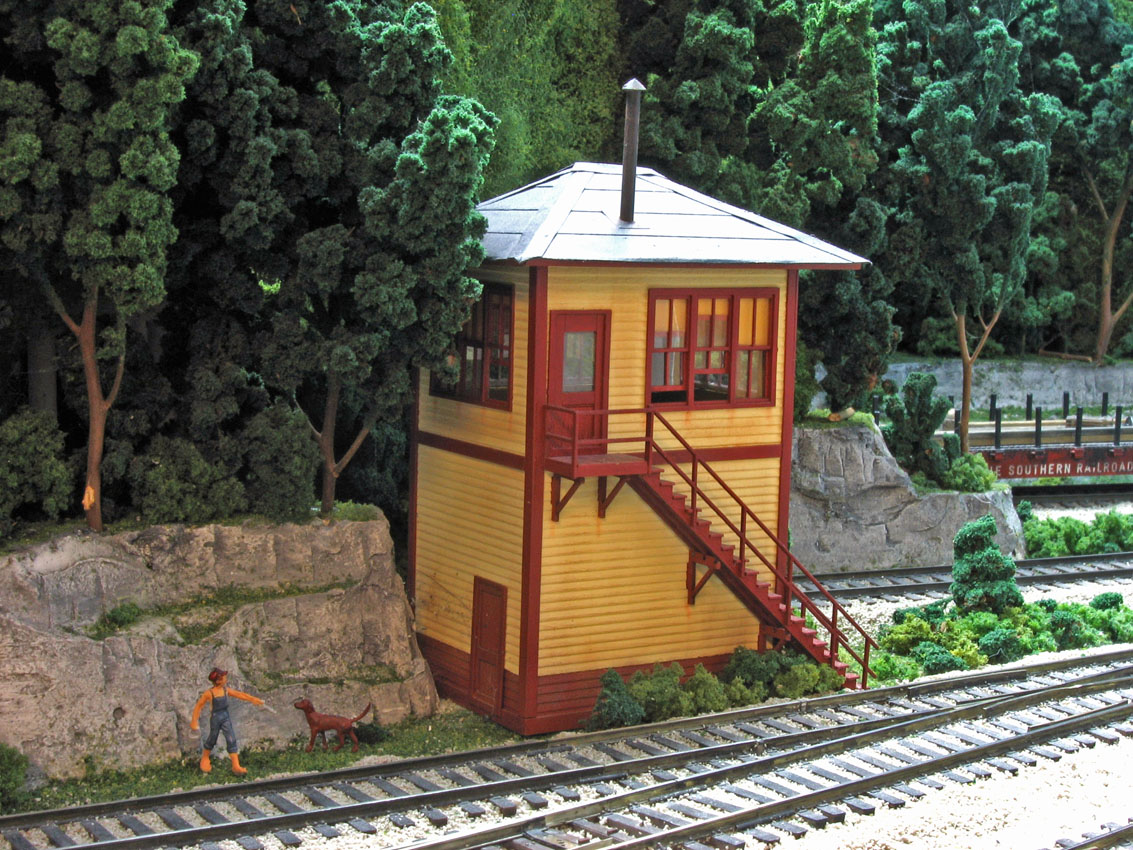
Interlocking Tower
(American Model Builders)
Painting Technique:
Clean look – for a refurbished looking tower
Straight painting of two coats ‘sand’ with ‘maroon’ trim (B&M colours)
Light weathering with pastel chalks.

Whistlestop Station
(Bar Mills)
Painting Technique:
Clean look – for a well-kept depot
Washes of ‘sand’ colour so as to not fill in the nail holes along the walls and straight maroon trim (B&M colours)
Application of Alcohol/India Ink solution.

Shipyard Brewery
(Bar Mills)
Painting Technique:
Heavily weathered look for older industrial appearance
Prime coat of grey in ‘splotchy’ fashion
Washes of red (two or three to achieve desired colour)
Sanding of walls to reveal primer and wood beneath paint
Additional washes of yellow then red
Application of Alcohol/India Ink solution
Note: The addition was done much later than the original building and the matching of the two paint jobs presented a slight challenge.

Small White Shack
(Bar Mills)
Painting Technique:
A series of washes of white paint.
Application of pastel chalks for weathering (earth and rust tones)
Final wash of white paint – the mix with the chalks and the wash proves effective.

Small Red Shack
(Bar Mills)
Painting Technique:
Prime coat of grey
A series of washes of red paint, then yellows
Finally, an application of Alcohol/India Ink.

Small Green Shack
(Bar Mills)
Painting Technique:
Board behind tar paper painted brown
Tar Paper painted green
Outer boards painted brown
All “peel and stick’ items allowing for ‘award-winning’ paint jobs!
Final wash of A/I mixture brought out all of the details.

Waterfront Willy’s
(Bar Mills)
Painting Technique:
A series of washes of yellows so as to not fill in nail holes
Smaller section painted grey and maroon with border painted white (peel and stick)
For this structure I took a risk and used a wash of ‘watered-down’ black paint as I had no India Ink available – turned out reasonably well.

Baxter Boats and Marine Services
(Scratchbuild)
This structure I made just after I got in the hobby over 15 years ago.
I recently named it after my friend, Jim Baxter. Will make a better sign eventually.
Painting Technique:
The structure used to be a midwestern yellow colour so this acted as the prime coat.
I repainted the structure white applying a couple of coats.
A wash of A/I helped bring out the detail in the wood.